 MAGNA BUREAU
The Wire
Death toll from Russian bombing of Ukrainian aid point rises to 53
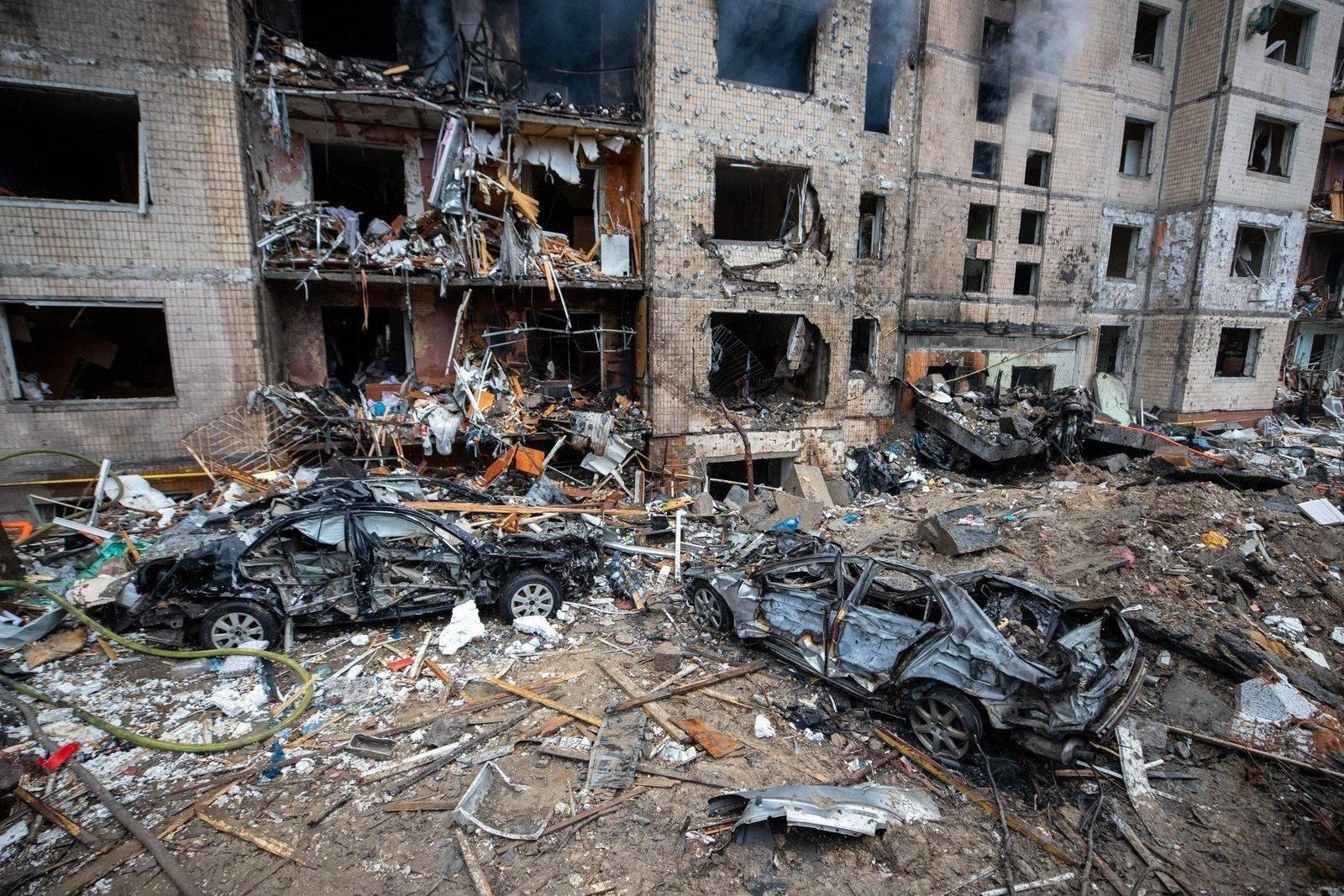
Russian guided bombs struck a former school in Komyshuvakha, in Ukraine’s Zaporizhzhia region, as residents gathered for their weekly aid distribution, and by Friday the toll had reached at least 53, with dozens still missing and the United Nations saying the attack likely violated international law.
Key points
- Russian guided bombs struck a former school in Komyshuvakha, Zaporizhzhia region, on Monday 2 November 2026, as residents gathered for a weekly humanitarian aid distribution. 1
- The death toll reached at least 53 by Friday 6 November: the State Emergency Service reported 50 in the morning, and acting governor Mykhailo Semikin later put the figure at 53. 2
- The United Nations human rights mission in Ukraine said nine aerial bombs fell in two waves and that the attack likely violated international law. 6
- Fifty-nine people were listed as missing, and as many as 39 may still be trapped under the rubble as the search entered its fifth day. 1
- Four police officers and two rescuers, Denys Konovalenko and Oleksii Sushchevskyi, both 44, were among the dead, and five people were wounded. Euromaidan Press
ONE EVENT. THREE READINGS.
How the West reads it.
In the West, the story is told as a toll, a condemnation and a piece of evidence.
What this reading highlights: Reuters and the Associated Press lead with the rising figures, 50 then 53, and with the United Nations mission’s finding that the strike likely violated…
How the Global South reads it.
In the Global South, the story is carried as a civilian tragedy with a legal judgment attached.
What this reading highlights: Al Jazeera leads with the toll and the fifth day of digging, Al Arabiya carries the United Nations condemnation, and Kenya’s Citizen Digital gives the…
Sources: Al Jazeera, Al Arabiya, Citizen Digital
Sources by lens: 2 West, 2 East, 3 Global South. See every source
THE POINT OF CONVERGENCE
Russian guided bombs struck a former school in Komyshuvakha, in Ukraine’s Zaporizhzhia region, on Monday 2 November 2026, as residents gathered for a weekly humanitarian aid distribution.
WHAT REMAINS CONTESTED
The exact toll, since the State Emergency Service reported 50 on Friday morning while the acting governor later put the figure at 53, and the governor’s figure has not been independently verified.
The story
What happened at the aid point in Komyshuvakha?
On Monday 2 November 2026, Russian guided bombs fell on a former school in Komyshuvakha, a village in Ukraine’s south-eastern Zaporizhzhia region, just as residents had gathered for their weekly aid distribution. The distribution had been announced the day before, and the building had become the village’s shelter and its lifeline. The United Nations human rights mission in Ukraine said nine aerial bombs struck the village in two waves, and Ukrainian officials said the second wave hit the underground shelter where people had taken cover after the first explosions.
By Friday 6 November, the fifth day of the search, the death toll had climbed to at least 53. Ukraine’s State Emergency Service said in the morning that the toll had reached 50 after eight more bodies were pulled from the rubble, and the acting regional governor, Mykhailo Semikin, later put the figure at 53, while rescuers were still digging for the missing. The toll had risen almost every day since the strike, from 26 in the first counts to 42 on Thursday.
Among the dead are four police officers and two rescuers, Denys Konovalenko and Oleksii Sushchevskyi, both 44, and five people were wounded, according to the Ukrainian authorities. Body-camera footage from one of the police officers killed, verified by Reuters, shows the moments before a second strike destroyed the shelter where residents were hiding, and it is that second strike that Kyiv and the United Nations have put at the centre of the case against Moscow.
What have the rescuers and the monitors established?
The site itself is not in dispute. The former school had been closed for classes for a long time because Komyshuvakha sits about 17 kilometres from the nearest Russian positions, yet every Monday it filled with residents who had stayed, collecting food and aid and using the underground rooms for shelter. Ukraine’s national police said the strikes included a three-ton FAB glide bomb, which carries around 1.4 tons of explosives
The figures are still moving, but the direction is one way. Local police said on Wednesday that 59 people were listed as missing, though some of them might be among the bodies already found, and the acting governor said as many as 39 people could still be trapped under the debris. Twelve bodies had been identified by 4 November, with DNA samples collected from relatives where visual identification was not possible.
What is still unresolved five days after the strike?
The final toll is not yet fixed, and it may not be fixed for days. The governor’s figure of 53 has not been independently verified, as Al Jazeera noted, and the gap between the 59 people listed as missing and the 30 to 39 believed to be under the rubble leaves open how many of the missing are already among the dead and how many are still buried.
What Moscow intended is the other open question, and the two accounts cannot both be true. Russia’s Defence Ministry said the attack targeted Ukrainian military units around Komyshuvakha and two other settlements, and that up to 25 Ukrainian servicemen were killed, but it has offered no public evidence for that claim. The United Nations mission put it plainly: either Russia knew civilians were gathering for aid, because the distribution was well publicised, or it failed to take basic precautions to verify the status of the site.
Why does a strike on an aid queue matter beyond Zaporizhzhia?
This is one of the deadliest Russian attacks on civilians this year, and one of the deadliest in more than four and a half years of war, and the reason it carries that weight is the place it struck. An aid distribution point is where a frontline village keeps itself alive, and the queue that formed there on Monday morning was made of the people who had refused to leave. When the bombs fell on a schedule published the day before, the strike hit not a hidden target but a gathering the whole village knew about.
It matters for the law as well as for the village. The United Nations human rights mission said the attack seems to have violated the most fundamental principles of international humanitarian law, and it placed the strike inside a wider pattern, noting that glide bombs had already killed at least 478 civilians and injured 2,667 people in Ukraine in 2026. The strike also came as the longest ceasefire between the two sides ended in the southern Kherson region, so it reads as a signal about the war’s direction just as trilateral talks on Ukraine are due to open in Abu Dhabi on 10 November.
What does the strike reveal about the war’s direction?
The first thing the strike reveals is how far apart the two accounts of this war now stand. Kyiv’s version is built on evidence anyone can check: a published aid schedule, a school full of civilians, rescuers and police officers among the dead, and body-camera footage of a second strike on a shelter. Moscow’s version rests on a single claim, that military units were the target, offered without evidence and without any answer to the civilian dead. The gap is not over interpretation but over what happened, and the United Nations mission has come down on the side of the evidence that can be seen.
The second revelation is the weapon itself. The glide bomb has become the instrument of this phase of the war, cheap, heavy and fired from beyond the reach of Ukrainian air defences, and its toll on civilians is now large enough to measure: 478 dead and 2,667 injured in 2026 alone, before Komyshuvakha. A bomb falling on a village 17 kilometres from the front, on a school whose aid schedule was public, shows how the weapon turns ordinary frontline life into a target.
The third is the timing. The strike landed days before the Abu Dhabi talks and in the same week that a meeting between Trump, Xi and Putin in Shenzhen was being discussed, and it followed the end of the longest ceasefire in the south. None of that proves a connection, but it sets the context in which the strike will be read: a war fought harder even as the diplomacy around it accelerates, and a Russian military that is deepening its partnerships abroad while it presses its advantage at home.
What follows for the rescue, the law and the front line?
For Komyshuvakha, the immediate consequence is that the village has lost its lifeline. The school that handed out aid every Monday is rubble, the rescuers who dug through it are burying two of their own, and the residents who depended on the weekly distribution must now find food and shelter somewhere else, in a settlement hit repeatedly since November 2025. The search will go on until the rubble gives up its last bodies, and the identification work, much of it by DNA, will take longer still.
For the law, the strike becomes another file in the record the United Nations mission is building, and its finding that the attack likely violated international humanitarian law will be quoted wherever Russia’s conduct of the war is judged. The mission documented what could be verified, the publicised distribution, the two waves of bombs and the civilian dead, and left the question of intent to the evidence.
For the front line, the lesson other villages will draw is bleak. A publicised aid distribution, a school, a shelter: none of it protected Komyshuvakha, and the next distribution in the next village will have to weigh the risk of gathering against the risk of going without. Humanitarian work in Zaporizhzhia was already carried out under fire; after Monday, gathering for aid is itself known to be the moment of greatest danger.
What happens in the coming days?
The search in Komyshuvakha enters its sixth day, and the toll is likely to move again as rescuers work through the rubble and DNA identification proceeds. The State Emergency Service and the acting governor, Mykhailo Semikin, are expected to update the figures, and the police list of 59 missing will be revised as bodies are identified. Whether Moscow answers the latest toll, it has not responded directly to Friday’s figures, will be watched.
Beyond the village, the calendar points to Abu Dhabi, where trilateral talks on Ukraine are scheduled for 10 and 11 November, and the Komyshuvakha toll will be part of the backdrop to those talks, a reminder of what the war is doing to civilians while diplomacy is arranged. In Zaporizhzhia, the question is simpler and more immediate: whether the next Monday brings another aid distribution, and whether anyone dares to queue for it.
What we agree on, and what remains open
Established
- Russian guided bombs struck a former school in Komyshuvakha, in Ukraine’s Zaporizhzhia region, on Monday 2 November 2026, as residents gathered for a weekly humanitarian aid distribution.
- The United Nations mission said nine aerial bombs fell in two waves.
- By Friday 6 November the death toll had reached at least 53, with 59 people listed as missing and the search in its fifth day.
Contested
- The exact toll, since the State Emergency Service reported 50 on Friday morning while the acting governor later put the figure at 53, and the governor’s figure has not been independently verified.
- The number still buried, put at more than 30 by some officials and up to 39 by others.
- What the target was, since Russia says it hit military units while Ukraine and the United Nations say the site was a civilian aid point.
Still open
- The final death toll, since the search continues and DNA identification is incomplete.
- How many of the 59 missing are already among the dead and how many are still under the rubble.
- What Russia intended, since its claim about military units has no public evidence behind it.
- The full condition of the five wounded.
What to watch
Questions, answered
Russian guided bombs struck a former school in Komyshuvakha, a village in Ukraine’s Zaporizhzhia region, as residents gathered for their weekly humanitarian aid distribution. The United Nations mission said nine aerial bombs fell in two waves, and Ukrainian officials said the second wave hit the underground shelter where people had taken cover.
The death toll reached at least 53 by Friday 6 November. Ukraine’s State Emergency Service reported 50 dead that morning after eight more bodies were recovered from the rubble, and the acting regional governor, Mykhailo Semikin, later put the figure at 53. Fifty-nine people were listed as missing, and the search entered its fifth day.
The United Nations human rights mission in Ukraine said the attack likely violated international law, calling it a breach of the most fundamental principles of international humanitarian law. Its head, Danielle Bell, noted that the aid distribution had been well publicised, so Russia either knew civilians were gathering or failed to take basic precautions.
Russia’s Defence Ministry said the attack targeted Ukrainian military units around Komyshuvakha and two other settlements, and that up to 25 Ukrainian servicemen were killed. It has offered no public evidence for that claim, has not addressed the evidence that the site was a civilian aid point, and has not responded directly to the latest casualty figures.