 MAGNA BUREAU
The Wire
Forty-seven years after the embassy siege, Tehran turns its November ritual into a verdict on Trump’s midterm defeat
Thousands marched from Palestine Square to the former US embassy as Iranian officials claimed the Democrats’ sweep proved American voters had rejected the war; a reading Washington is unlikely to share.
Key points
- November 4, 2026: Iran marked the 47th anniversary of the 1979 student seizure of the US embassy in Tehran; 52 Americans held hostage for 444 days, a rupture that ended formal diplomatic relations. Al Jazeera, 2026-11-04
- 900+ locations: state media reported rallies nationwide; the Tehran march began at 9 a.m. from Palestine Square and moved along Taleghani Street to the former embassy, under the slogan « Pledge to the Martyrs; Struggle Against Global Arrogance ». Mehr News Agency / IRNA, 2026-11-04
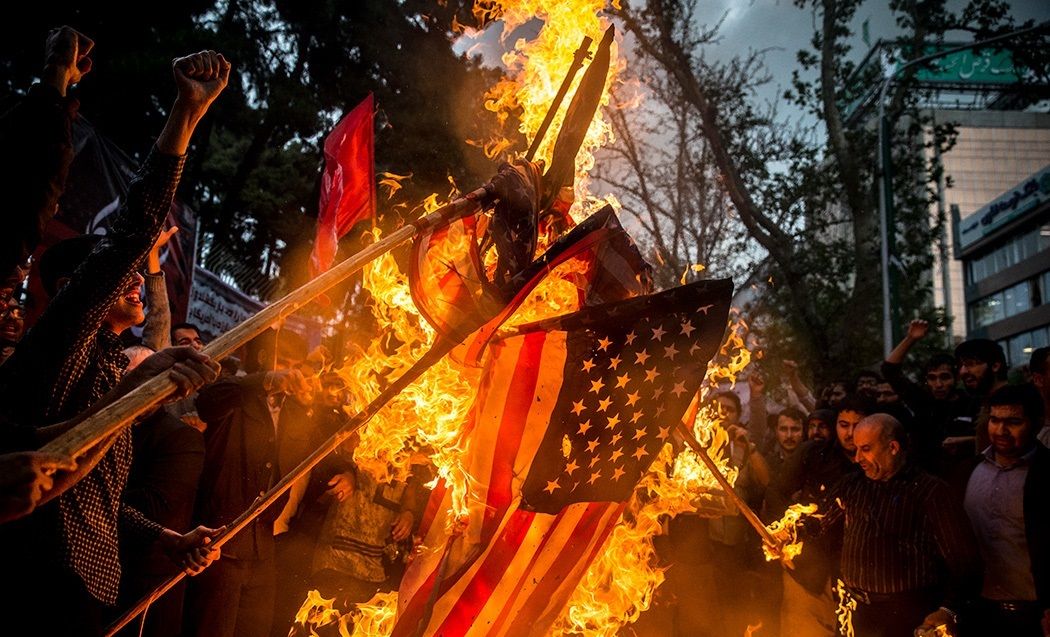
- Thousands in Tehran: crowds outside the former embassy burned American and Israeli flags, chanted « Death to America » and « Death to Israel », and carried effigies of Donald Trump and Benjamin Netanyahu; including a dartboard with their faces and a « We will kill Trump » banner. Reuters / Associated Press, 2026-11-04
- Officials’ message: Tehran Mayor Alireza Zakani proclaimed a « decisive defeat » for the US and Israel; Judiciary Chief Gholam Hossein Mohseni Ejehi posted on X that « Trump failed both in war and in politics » and promised « even more defeats ». Al Jazeera, 2026-11-04
- Warnings to Washington: Parliament Speaker and chief negotiator Mohammad Baqer Qalibaf warned on X against ignoring public opinion by attacking Iran again; Supreme Leader Mojtaba Khamenei said US hostility would persist regardless of which party holds power. CNA, 2026-11-04
ONE EVENT. THREE READINGS.
The view from Washington and Jerusalem: a threat wrapped in a ritual.
Seen from Washington and Jerusalem, the day’s imagery drowned out its politics.
What this reading highlights: The Associated Press frame that traveled widest in the West led with the « We will kill Trump » banner and the burning flags, and…
The view from Singapore: an election, read from the other side.
CNA’s account was cooler and more election-centered: Iranian officials « savouring the stinging rebuke delivered to Donald Trump », Speaker Qalibaf posting that Washington should not ignore public opinion, and Supreme Leader Mojtaba Khamenei’s written statement that American hostility would persist regardless of which party holds power; a warning against over-reading the Democratic win.
What this reading highlights: The Eastern telling treats the Hamshahri front page and the dartboard photographs as information operations, and focuses on the structural fact beneath the gloating: a…
Sources: CNA
The view from the region: the rite and its double standard.
Al Jazeera’s gallery and the Iranian agencies carried the day’s mechanics straight, the marches, the slogans, the claims of « decisive defeat », in the cooler register the Global South uses for anti-imperialist ritual.
What this reading highlights: Underneath sits a question Western coverage rarely asks: who gets sanctioned, bombed and excluded, and who decides.
Sources: Al Jazeera, Mehr News Agency, Press TV, IRNA
Sources by lens: 1 West, 1 East, 4 Global South. See every source
THE POINT OF CONVERGENCE
On November 4, 2026, Iran marked the 47th anniversary of the 1979 student seizure of the US embassy in Tehran, 52 hostages held for 444 days, a rupture that ended formal diplomatic relations, with rallies at more than 900 sites nationwide, centered on a march from Palestine Square to the former embassy, where crowds burned American and Israeli flags and officials publicly tied the occasion to the US midterm results.
WHAT REMAINS CONTESTED
Whether the midterm outcome was truly a verdict on the Iran war or a broader verdict on tariffs, prices and a turbulent second term.
The story
What Tehran did on the anniversary
At nine o’clock Wednesday, crowds left Palestine Square and moved down Taleghani Street to the compound Iranians call the Den of Espionage; the former United States embassy stormed forty-seven years ago. At the embassy gates the ritual was in full swing: American and Israeli flags set alight, portraits of Donald Trump and Benjamin Netanyahu on placards and a dartboard, and « Death to America », « Death to Israel » echoing through the streets. It was the National Day of Fighting Global Arrogance, but this year’s march carried a second occasion inside it: the American midterms held the day before, in which voters stripped Trump’s Republicans of both chambers of Congress. The timing was the message.
Tehran’s mayor, Alireza Zakani, told the crowd the United States and Israel had suffered a « decisive defeat ». The judiciary chief, Gholam Hossein Mohseni Ejehi, posted on X that « Trump failed both in war and in politics », adding: « We will certainly impose even more defeats upon him. » And the parliament speaker, Mohammad Baqer Qalibaf, also Tehran’s chief negotiator, warned Washington on X against ignoring public opinion by attacking Iran again. The day’s slogan was « Pledge to the Martyrs; Struggle Against Global Arrogance », and state media reported rallies at more than 900 locations nationwide.
What the march actually showed
The route and timing, 9 a.m. from Palestine Square to the former embassy, were announced in advance and confirmed by the state agencies Mehr and IRNA, which put the number of rally sites nationwide above nine hundred. On the crowd’s scale the accounts diverge: Iranian state outlets spoke of millions across the country, while the international wires described thousands outside the former embassy, and no independent estimate exists.
What the cameras recorded is not in dispute. Reuters published photographs of demonstrators holding a dartboard bearing the faces of Trump and Netanyahu; the Associated Press photographed a supporter carrying a banner reading « We will kill Trump », days after a billboard with the same threat was unveiled over Tehran; and the flag burnings were confirmed by every outlet present. The officials’ words are on the record in their own channels, and the history is settled: on November 4, 1979, students seized the embassy and held 52 Americans for 444 days, and Washington and Tehran have had no formal diplomatic relations since.
Death to America
What the crowds cannot tell us
A rally is a poor instrument for measuring a country. How many actually marched? The state’s « millions » cannot be verified, the wires’ « thousands » cannot be scaled to 900 claimed sites, and nobody without a stake in the answer has published a count. How much of the crowd was mobilized, students channelled by schools along a route where the organizers advertised « special programs », and how much was spontaneous? And what does the menace mean: is a « We will kill Trump » banner deterrence, a pressure tactic ahead of negotiations, or domestic theater? The photograph cannot tell us.
Nor is the sincerity of the midterm reading itself established. Did Tehran’s leadership truly conclude that American voters delivered a verdict on the war, or did it seize the nearest stick with which to beat Washington? The same voters punished tariffs, living costs and two years of turbulence; motives the gloating leaves out of frame. And the unknown that matters most: will any of this change American behavior. The crowds have gone home; the aircraft carriers have not.
Why this year’s ritual carries a different weight
Every November 4 is political theater in Tehran; this one played against live ammunition. It is the first Aban 13 since the war began, the first since American strikes hit Iran and Tehran answered, as its supreme leader put it, with control over Hormuz and strikes on US bases, and the first under open threats of renewed American attacks, against which Khamenei has warned of « broader retaliation ». Into that atmosphere dropped the midterm result, less than a day old: the Democrats seized both chambers in an election described as a rebuke of Trump’s second term, his tariff wars and the conflict with Iran. Tehran did not have to invent a narrative; it had only to point at the American one.
That is what makes the gloating strategically legible. For months the regime’s wager has been that it can outlast American pressure; that the costs of the war and the sanctions will break Washington’s will before they break Iran’s. A midterm verdict, however partially attributable to the war, is the first American-made evidence the regime can cite. The Hamshahri front page made the claim explicit: Trump blindfolded and head bowed under « Iran’s shadow over US elections », declaring Washington « 47 years Iran’s captive ». A front page is not a fact, but in an information war it is a weapon; aimed as much at Iranian domestic morale as at the Americans.
How Tehran is reading the American vote
Run the regime’s reading through the five dimensions and its confidence starts to look reasoned. Geopolitically, the Democrats’ capture of both chambers gives Tehran something it has lacked since the war began: an American institutional check on the president who ordered the strikes. A hostile Congress cannot stop a war alone, but it can investigate it and strangle its funding; friction the regime hopes will slow any march toward renewed attacks. Economically, the American vote was also a verdict on costs, and Tehran will have noted that the war is now a line item in US domestic politics, exactly where Iran wants it.
Historically, the continuity is the point: forty-seven years after the seizure that made « Death to America » a state slogan, the regime is still in power, still sanctioned, still at war with the same adversary, and now quoting American voters in its defense. The 444-day crisis taught Tehran that America can be waited out. And technologically, the medium accelerates the message: the X posts, the Hamshahri front page engineered for screenshots; the whole day was produced for circulation, and it circulated. The honest caveat: Tehran may be reading what it wants to read. American voters punished many things on November 3, and a Democratic Congress holds tools of harassment rather than tools of peace.
How far does a « decisive defeat » actually travel?
Follow the midterm result into the machinery and the gloating starts to leak. A Democratic Congress can damage a president’s agenda, investigations, subpoenas, blocked legislation, but it cannot override a veto and cannot command the military; the war powers that matter for Iran sit with the executive, and the executive just said, through Trump, that he has « no regrets » and would launch the war again. The open question of whether Trump is signalling a return to war survives the election intact, and Tehran knows it; which is why Qalibaf’s warning and Khamenei’s « broader retaliation » threat accompanied the celebration. The regime is gloating and bracing at once, and the brace is the more honest signal.
The second-order effects run through the region’s chokepoints. If congressional pressure slows American escalation, Iran’s leverage over the Strait of Hormuz, the asset Khamenei himself cited as retaliation currency, holds its value as deterrence, and markets price relief, not resolution. If instead the administration doubles down abroad to recover strength at home, the rallies’ threats stop being theater and start being targeting data.
What happens after the banners come down?
The banners will be folded away; the indicators will not. First, American force posture: any carrier movement, any new strike authorization, any hardening of Washington’s language will show faster than any speech whether the midterm constraint is real or decorative, and Khamenei’s « broader retaliation » warning has put a price on finding out. Second, the new Congress’s first moves on war powers: hearings, resolutions, funding riders, noise or teeth, the distinction will be visible within weeks. Third, Tehran’s discipline: whether the regime keeps quoting the midterms or quietly pivots back to deterrence if Washington calls the bluff. The ritual is annual; the war is not on a schedule.
What we agree on, and what remains open
Established
- On November 4, 2026, Iran marked the 47th anniversary of the 1979 student seizure of the US embassy in Tehran, 52 hostages held for 444 days, a rupture that ended formal diplomatic relations, with rallies at more than 900 sites nationwide, centered on a march from Palestine Square to the former embassy, where crowds burned American and Israeli flags and officials publicly tied the occasion to the US midterm results.
Contested
- Whether the midterm outcome was truly a verdict on the Iran war or a broader verdict on tariffs, prices and a turbulent second term.
- Whether the flag burnings and threat banners express popular feeling or staged state theater.
- Whether Tehran’s gloating is deterrence, propaganda, or both at once.
Still open
- The real size of the crowds, with state media’s « millions » unverified and wire agencies reporting « thousands ».
- Whether any change in US policy toward Iran will follow the Democratic sweep.
- Whether Tehran’s reading of American voters is accurate or self-serving.
- What « broader retaliation » would look like if Washington renews its attacks.
What to watch
Questions, answered
The 47th anniversary of the November 4, 1979 seizure of the US embassy in Tehran by students, who held 52 Americans hostage for 444 days; the rupture that ended formal US-Iran diplomatic relations. The date also marks the 1964 exile of Ayatollah Khomeini and the 1978 killing of protesting students. Iran observes it annually as the National Day of Fighting Global Arrogance, with rallies at what state media says were more than 900 locations this year.
The rallies fell one day after the November 3 midterms, in which voters stripped Donald Trump’s Republicans of both chambers of Congress. Iranian officials seized the timing: Tehran’s mayor declared a « decisive defeat » for the US and Israel, the judiciary chief posted that « Trump failed both in war and in politics », and state media framed the result as American voters rejecting the war against Iran.
Parliament Speaker Qalibaf warned Washington on X not to ignore public opinion by attacking Iran again. Supreme Leader Mojtaba Khamenei said in a written statement that US hostility would persist regardless of which party holds power, and separately warned of « broader retaliation » if the US renews its attacks. Foreign Ministry spokesman Esmaeil Baghaei claimed voters sent a « NO TO WAR » message; Trump acknowledged the war hurt his party but said he would do it again.