 MAGNA BUREAU
The Wire
After Twelve Silent Years, the New Yalu River Bridge Opens Between China and North Korea
China and North Korea formally opened the long-delayed New Yalu River Bridge on October 15, 2026; a four-lane, 3,026-metre crossing between Dandong and Sinuiju that stood finished-but-unused for a dozen years. Beijing and Pyongyang hail a new chapter in their friendship; experts are split on whether concrete can move trade where sanctions and politics set the limits.
Key points
- On October 15, 2026, China and North Korea jointly opened the New Yalu River Bridge between Dandong and Sinuiju in a ceremony with video messages from Chinese Premier Li Qiang and North Korean Premier Pak Thae-song. <a href=”https://businessmirror.com.ph/2026/10/15/china-north-korea-bridge-opens-after-more-than-a-decade-of-delay/” target=”_blank” rel=”noopener”>Associated Press</a> (15 Oct 2026)
- The bridge is a four-lane, 3,026-metre cable-stayed crossing with a 28.5-metre-wide deck and navigation clearance for 3,000-tonne vessels; China agreed to build it in 2010 and financed it at a reported cost of about US$310–350 million. <a href=”https://peoplesdaily.pdnews.cn/china/er/30053344760” target=”_blank” rel=”noopener”>Xinhua / People’s Daily</a> (15 Oct 2026)
- China completed its side in October 2014, but the bridge stood unused for about twelve years because North Korea had not built connecting roads or customs facilities on its side; the approach works were only finished in 2026. <a href=”https://www.reuters.com/world/china/north-korea-says-opening-ceremony-was-held-new-bridge-china-2026-10-15/” target=”_blank” rel=”noopener”>Reuters</a> (16 Oct 2026)
- Two-way China–North Korea trade grew 25 percent in 2025 to US$2.74 billion and nearly 20 percent in the first half of 2026 to US$1.5 billion, putting it on track for its highest volumes since the pandemic, per China’s customs data. <a href=”https://www.aljazeera.com/economy/2026/10/16/china-north-korea-border-bridge-may-do-little-to-spur-trade-experts-say?traffic_source=rss” target=”_blank” rel=”noopener”>Al Jazeera</a> (16 Oct 2026)
- Experts are split on the trade impact: Phillip Park notes the bridge “does not remove international sanctions,” while Christopher Green of the International Crisis Group says the trade “is fundamentally driven by politics”; not by the number of lanes. <a href=”https://www.aljazeera.com/economy/2026/10/16/china-north-korea-border-bridge-may-do-little-to-spur-trade-experts-say?traffic_source=rss” target=”_blank” rel=”noopener”>Al Jazeera</a> (16 Oct 2026)
ONE EVENT. THREE READINGS.
Through the Western lens, this is first a sanctions story.
CNN framed the opening around expert concern that the corridor could ease Pyongyang’s evasion of UN sanctions over its nuclear programme; whose military dimension stays active, as recent missile activity near the demilitarized zone underlined.
What this reading highlights: The question in Washington and Seoul is not the bridge’s legality but its manifests: whether the UN Panel of Experts can monitor a four-lane flow…
Sources: Associated Press, Reuters, CNN
Through the Eastern lens, it is a friendship story; and a strategic one.
Xinhua and KCNA present a relationship entering “a new chapter,” with Li’s pledge to prioritize the China-DPRK friendship “no matter how the international situation may change.” Analysts read a competitive logic underneath: Beijing reasserting primacy in Pyongyang as North Korea’s ties with Moscow deepen; last month’s first Russia–North Korea road bridge over the Tumen, and North Korean troops deployed to Russia’s war in Ukraine, a partnership examined in our coverage of the Korea-Ukraine prisoner dispute .
What this reading highlights: The Yalu bridge is China’s answer: the older ally reminding Pyongyang who built the bigger road.
Sources: Xinhua / People’s Daily, KCNA via Korea JoongAng Daily
Through the Global South lens, it is a development story with a sceptical edge.
Al Jazeera, the most analytically ambitious coverage of the day, argues the crossing “may do little to spur trade,” because the binding constraints are sanctions and a Pyongyang leadership that “prioritises security above all else.” From the borderlands, Dandong’s shopkeepers and Sinuiju’s traders care less about communiqués than about whether trucks move and shelves fill.
What this reading highlights: Twelve years of waiting taught them to distinguish a ribbon-cutting from a recovery.
Sources: Al Jazeera
Sources by lens: 3 West, 2 East, 1 Global South. See every source
THE POINT OF CONVERGENCE
On October 15, 2026, China and North Korea jointly opened the New Yalu River Bridge between Dandong and Sinuiju after a ceremony with video messages from premiers Li Qiang and Pak Thae-song.
WHAT REMAINS CONTESTED
On whether the bridge will meaningfully expand trade; Beijing and Pyongyang hail a new chapter, while analysts split between those who see transformative capacity and those who argue politics and sanctions, not concrete, set the ceiling.
The story
On Thursday morning, October 15, 2026, China and North Korea jointly
On Thursday morning, October 15, 2026, China and North Korea jointly opened the New Yalu River Bridge, the four-lane crossing between the Chinese city of Dandong, in Liaoning province, and the North Korean city of Sinuiju, in a ceremony held on both banks of the river that divides them.
China’s Xinhua News Agency reported that Chinese Premier Li Qiang and North Korean Premier Pak Thae-song each delivered video messages. Li declared relations had “entered a new stage, embarking on a new chapter,” and called the bridge “a new landmark symbolizing the two nations’ traditional friendship,” urging both sides to deepen connectivity and border cooperation.
Pak said the bridge would “accelerate the advance for the prosperity of the two countries” and “add fresh vigour to the equally-beneficial economic cooperation.” State media showed flag-decorated trucks on the deck and crowds in Dandong watching the first lorries cross in both directions. KCNA, reporting Friday, called it “the creation reflecting the invincible vitality and development of the DPRK-China friendship,” and said ambassadors Ri Ryong-nam and Wang Yajun attended in person. Reuters noted neither leader detailed the bridge’s purpose; but Li reaffirmed Beijing would keep “its firm attitude to highly prioritize the China-DPRK friendship no matter how the international situation may change.”
Why did the bridge sit unused for twelve years?
The New Yalu River Bridge, the Amnok River Bridge on the Korean side, is a cable-stayed structure 3,026 metres long, with a 28.5-metre deck carrying four lanes and navigation clearance for 3,000-tonne vessels. The two countries agreed to build it in 2010, during then-Premier Wen Jiabao’s visit to Pyongyang; construction began in October 2011 at a reported Chinese cost of roughly US$310–350 million. The Chinese side was substantially complete by October 2014; and then nothing happened. For about twelve years the finished bridge ended, famously, in a field outside Sinuiju: North Korea had not built the connecting roads or customs facilities on its side.
The stall was never officially explained. The AP’s reporting captured the speculation: Pyongyang may have feared deeper economic dependence on China, resented Beijing’s votes for UN resolutions tightening sanctions over its nuclear programme, or disagreed over the location. In 2017 Yonhap reported Pyongyang demanding Beijing cover more costs; in 2019 Xi Jinping reportedly pledged to fund the North-side roads and customs posts. Work started late 2019, stopped and restarted through 2020, and the approach works were only completed this year.
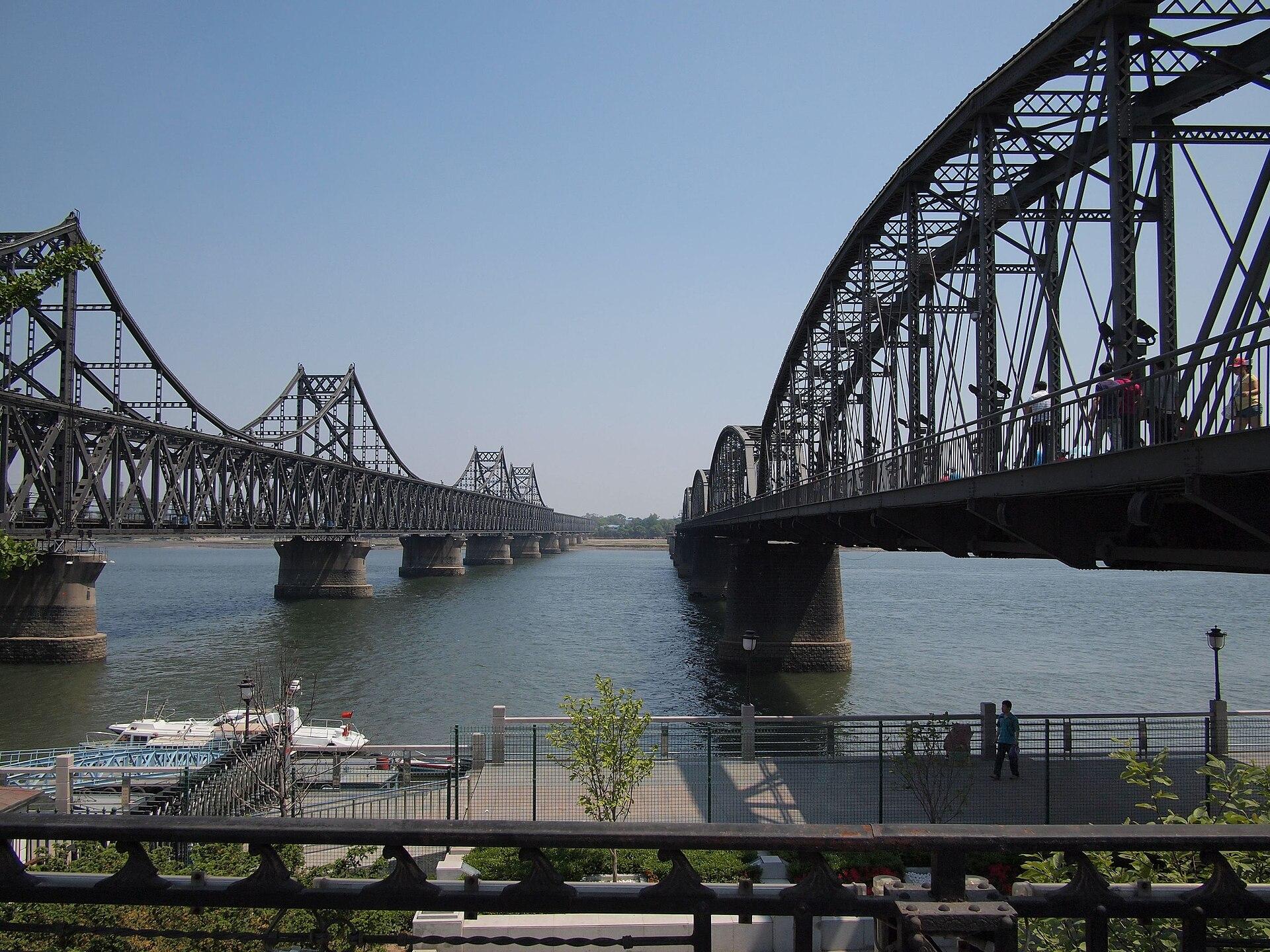
The bridge relieves the ageing Sino-Korean Friendship Bridge nearby: completed in 1943, with a single rail track and one reversible road lane limited to 20-tonne trucks; until Thursday, the only road-and-rail route between Dandong and Sinuiju. The steel spans in the photograph above are those old Dandong crossings.
entered a new stage, embarking on a new chapter,
What we do not yet know is how the bridge will actually be used
What we do not yet know is how the bridge will actually be used. Neither government has published the customs regime, inspection protocols, fees, or any target for daily crossings. We do not know what goods will cross first, nor whether anything beyond road freight, utilities, pipelines, data links, was even discussed. No passenger arrangement has been announced, and North Korea has not resumed tourist visas for Chinese visitors.
Nor is it clear how sanctions monitors will treat the new corridor. The bridge is civilian infrastructure, but the line between permitted commerce and prohibited transfers runs through exactly the heavy-machinery and construction-material shipments analysts expect; policed, imperfectly, by a UN sanctions regime both governments have strained against for years.
This is not a bridge between ordinary neighbours
This is not a bridge between ordinary neighbours. China accounts for as much as 95 percent of North Korea’s official trade, and the Dandong–Sinuiju corridor handles an estimated 70 percent of that commerce. For over a decade the entire flow squeezed through a single-lane, 20-tonne-limited bridge built during the Second World War. The new crossing multiplies the main artery’s capacity several times over; Lim Eul-chul of Kyungnam University estimates it could triple or quadruple cargo traffic, especially heavy machinery and construction materials.
It is also a barometer of the Beijing–Pyongyang relationship, which has swung from Cold War intimacy to open strain and back. After the mid-2000s nuclear tests and the sanctions that followed, ties chilled and the finished bridge stood idle as a monument to the freeze. They have warmed markedly under Xi Jinping and Kim Jong Un; a seventh summit since 2018 this June, pledges across trade, defence, agriculture, law, science and technology, and a reopened rail link in March. The bridge is the most visible physical expression of that thaw: proof, in concrete, that the political will now exists.
For Dandong, the stakes are local and immediate. Residents watched a finished bridge gather dust for twelve years while their border economy idled; the Global Times once aired their frustration in unusually sharp terms. Thursday’s crowds, hundreds strong, showed how much symbolic weight the opening carries on the Chinese bank.
Will the new bridge weaken UN sanctions on North Korea?
Honestly: the bridge changes the geometry of enforcement without changing its rules. No bridge repeals a Security Council resolution, as Phillip Park of Seoul’s University of North Korean Studies told Al Jazeera, it “does not remove international sanctions.” What it does is widen the channel that must be monitored, legal and illicit flows alike, and monitoring was already the weak link.
The deeper debate is what actually drives the trade. Optimists like Jae-woo Joo of Kyung Hee University say the bridge could “tremendously” boost commerce, including restricted-component transfers. Sceptics reply the throttle was never the tarmac: Christopher Green of the International Crisis Group calls the trade “fundamentally driven by politics”; “lack of cross-border transit routes is not the main obstacle.” If the opening signals political permission for higher volumes, trade rises; if it is ceremony without commitment, four lanes carry little more than one did.
The numbers arm both camps. Two-way trade grew 25 percent in 2025 to $2.74 billion and nearly 20 percent in H1 2026 to $1.5 billion; the best since the pandemic, per Chinese customs. Yet against China’s $6.36 trillion in 2025 trade, North Korea was barely 0.04 percent, and the $5–6 billion annual flows of the 2010s (peaking at $6.45 billion in 2013) remain distant. The bridge moves the marginal truck; only politics moves the trend. See our analysis of China’s broader export surge for context.
Second-order effects start with the monitors
Second-order effects start with the monitors. The UN Panel of Experts, already under political pressure, now faces a corridor with several times the old bridge’s throughput and no published inspection regime. Expect Western capitals to demand manifest transparency, and the dual-use question, heavy machinery, construction materials, electronics, to dominate quiet diplomacy. Pyongyang’s procurement networks have repeatedly adapted to tighter scrutiny; a wider legal channel is also a wider channel to hide in, as the record of sanctioned weapons testing reminds observers.
Then the Moscow dimension. The Tumen road bridge opened only last month, and Russia–North Korea cooperation has given Pyongyang its first second patron in decades to play against the first. Beijing’s bridge is partly a bid to stay the indispensable one. How Pyongyang balances the two corridors, and what each patron extracts for its concrete, will shape Northeast Asian diplomacy well beyond freight statistics. For Dandong itself, twelve deferred years of warehouses, logistics firms and property speculation now hinge on whether the trucks actually come.
What will move across the bridge first?
The first hard data comes from China’s customs monthly releases: volume and, crucially, composition. Food and consumer goods would signal normalization; heavy machinery, the infrastructure push Lim Eul-chul anticipates; anything on the prohibited lists, an enforcement crisis. The June Xi–Kim pledges, trade, defence, agriculture, law, science and technology, are the checklist; the bridge is deliverable number one. The UN sanctions committee’s next cycle will show whether monitors get access.
And the human question the ceremony skipped: movement of people. Rail resumed in March, but tourist visas stay suspended and no passenger arrangement was announced. A bridge that moves goods but not people is a particular kind of openness; one that says much about the priorities on either bank.
What we agree on, and what remains open
Established
- On October 15, 2026, China and North Korea jointly opened the New Yalu River Bridge between Dandong and Sinuiju after a ceremony with video messages from premiers Li Qiang and Pak Thae-song.
- The four-lane, 3,026-metre crossing had stood finished-but-unused since China’s side was completed in 2014.
Contested
- On whether the bridge will meaningfully expand trade; Beijing and Pyongyang hail a new chapter, while analysts split between those who see transformative capacity and those who argue politics and sanctions, not concrete, set the ceiling.
Still open
- The customs and inspection regime, what categories of goods will actually cross, whether tourist or passenger movement will resume, or how UN sanctions monitors will treat the new corridor.
What to watch
Questions, answered
The bridge officially opened on Thursday, October 15, 2026, in a joint ceremony held on both banks. Chinese Premier Li Qiang and North Korean Premier Pak Thae-song delivered video messages, while North Korea’s ambassador to China, Ri Ryong-nam, and China’s ambassador to North Korea, Wang Yajun, attended the event in person on site.
China completed its side in October 2014, but North Korea never built the connecting roads or customs facilities on its side. Analysts cite Pyongyang’s wariness of deeper economic dependence on China, resentment over Beijing’s votes for UN sanctions, possible disputes over the location, and later the pandemic border closure. The North Korean approach works were only finished in 2026.
The new bridge is a four-lane, 3,026-metre cable-stayed crossing with a 28.5-metre deck. The old Sino-Korean Friendship Bridge, completed in 1943, has a single rail track and one reversible road lane limited to 20-tonne trucks. One North Korea specialist estimates the new crossing could triple or quadruple cargo traffic between Dandong and Sinuiju.
A bridge cannot repeal sanctions, and experts stress it changes enforcement geometry without changing the rules. The risk, flagged by analysts and Western capitals, is that a wider legal channel is harder for the UN Panel of Experts to monitor; especially for dual-use goods like heavy machinery. Whether trade grows depends on political decisions in Beijing and Pyongyang, not on the concrete.
China accounts for as much as 95 percent of North Korea’s official trade, and the Dandong–Sinuiju corridor handles roughly 70 percent of that commerce. Bilateral trade reached $2.74 billion in 2025, up 25 percent, and $1.5 billion in the first half of 2026. Even so, it is barely 0.04 percent of China’s $6.36 trillion in total 2025 trade.